US President Trump Considers New Tariffs on Indian Rice Imports


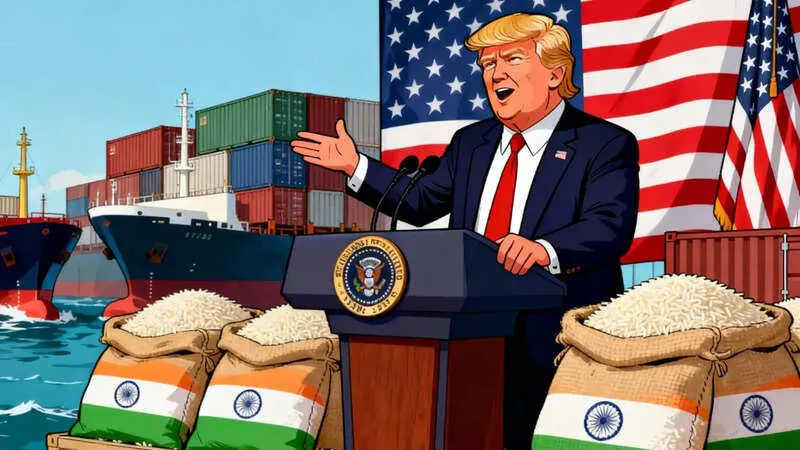
United States President Donald Trump has indicated the possibility of imposing additional tariffs on Indian rice imports, claiming that India is 'dumping' rice into the American market. During a recent roundtable discussion at the White House with representatives from the agricultural sector, Trump stated he would 'take care' of the situation, emphasising that tariffs could 'easily resolve the problem'. Currently, Indian goods exported to the United States are subject to a 50% tariff, one of the highest rates globally.
Trump's comments arose as he unveiled a $12 billion federal aid package aimed at supporting American farmers. At this meeting, he questioned Treasury Secretary Scott Bessent about India's trade practices, specifically asking, "Why is India allowed to do that? They have to pay tariffs. Do they have an exemption on rice?" Bessent confirmed that there was no exemption, adding that discussions regarding a trade deal with India were still ongoing.
The conversation shifted to the ongoing World Trade Organisation case concerning India's trade practices. Ajay Srivastava, founder of the Global Trade Research Initiative, suggested that Trump's threats regarding new tariffs were more politically motivated than based on sound trade principles. Srivastava noted that India exported approximately $392 million worth of rice to the United States in the financial year 2025, which constituted only 3% of its total rice exports. He pointed out that the majority of these exports involved premium basmati rice, which would likely remain unaffected by new tariffs due to established markets in other countries.
According to Srivastava, any new duties would primarily impact American consumers, raising the cost of rice. He stated, "India should view this as election-season messaging aimed at US farmers—not a substantial policy change—and refrain from making concessions that could disadvantage US consumers more than Indian producers."
The Indian Rice Exporters Federation (IREF) has responded to Trump's remarks by clarifying the dynamics of the Indo-US rice trade. Dev Garg, Vice President of IREF, affirmed the resilience and competitiveness of the Indian rice export industry. He stated, "While the US is a significant market, our rice exports are well-diversified across various global markets. We are actively working to strengthen existing trade partnerships and explore new opportunities for Indian rice."
In the financial year 2024-2025, India exported Basmati rice worth $337.10 million to the United States, with a volume of 274,213.14 metric tonnes (MT), making the US the fourth-largest market for Indian Basmati rice. In contrast, non-Basmati rice exports to the US totalled $54.64 million, putting the US at the 24th position for Indian non-Basmati rice exports. IREF noted that the consumption of Indian rice in the US is predominantly driven by ethnic communities from the Gulf region and South Asia, with rising demand linked to the growing popularity of Indian cuisine.
IREF further explained that Indian rice exports are primarily determined by consumer demand, and exporters fulfil pre-arranged orders from US importers. The unique qualities of Indian Basmati rice—such as its aroma, texture, and flavour—distinguish it from US-grown varieties, which are generally not suitable for traditional dishes from the Gulf and South Asian regions.
Before the recent tariff change, Indian rice imports faced a 10% tariff in the US, which has now been raised to 50%. Despite this increase, exports have continued, underscoring the essential role of Indian rice in the American market. Observations from retail markets indicate that the burden of the tariff is largely falling on US consumers, as evidenced by rising retail prices, while Indian producers and exporters have maintained stable revenue levels. IREF reported that the majority of the tariff costs are being passed on to US consumers, reflected in higher prices for retail packs, while the income for Indian farmers and exporters has remained relatively unchanged.

India Plans Major Investment in Electric Vehicle Infrastructure